Machine Learning System Design Interview

Recommenders, ranking and experiments at production scale.

50 traps, Nov 2025 to Jun 2026. Complete.

Set in interviews at Meta (13), OpenAI (9), Google DeepMind (7) and Netflix (5).

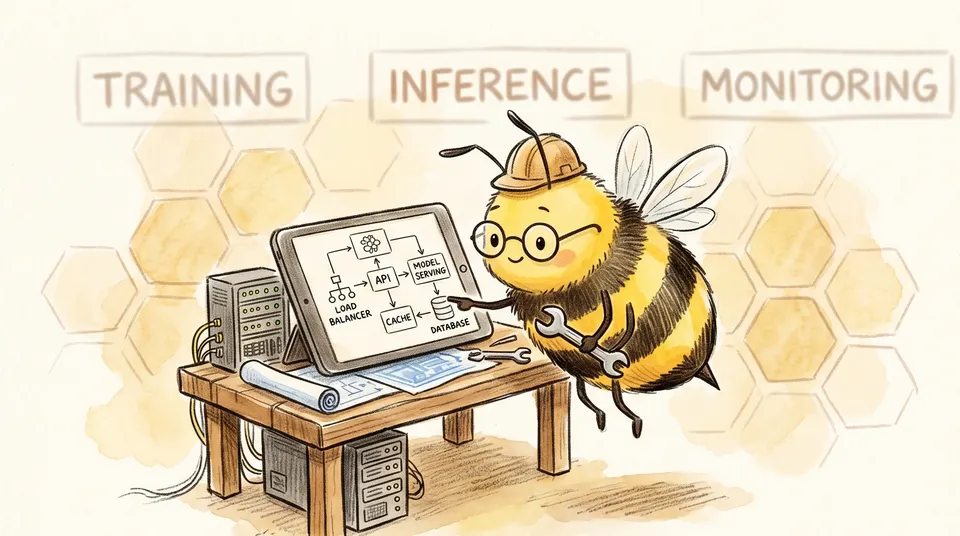
The bee for Machine Learning System Design Interview, drawn at a desk

Each trap: the interviewer’s question, the answer most candidates give, and the mechanism that breaks it. The full answers are on Substack.

  1. Senior ML Engineer interview at Netflix

    The Delayed Reward Illusion

    We are launching a new recommendation variant. Under what infrastructure constraints and business risks is a Multi-Armed Bandit (MAB) the wrong choice over a basic A/B test?

    ML System Design #50
    Jun 7, 2026

  2. Senior ML Engineer interview at Google DeepMind

    The Cross-Entropy Trap

    We’re deploying a stateful neural network backbone that continuously updates on a non-stationary data stream. Our standard cross-entropy loss is massively accelerating catastrophic forgetting. What alternative representational objective do you implement to stop the bleeding, and why?

    ML System Design #49
    Jun 6, 2026

  3. Senior LLM Engineer interview at Meta

    The Low-Rank Capacity Trap

    Your team used a standard LoRA for continual pre-training on a massive, complex new domain to save vRAM. But the model’s performance is severely inferior to a full fine-tune. How do you modify the adapter architecture and optimization strategy to bridge this gap?

    ML System Design #48
    Jun 5, 2026

  4. Senior ML Engineer interview at Google DeepMind

    The EWC Rigidity Trap

    You deploy Elastic Weight Consolidation (EWC) to fix catastrophic forgetting during continual fine-tuning. The model successfully retains its historical accuracy, but its adaptation to the new domain completely stalls. Why?

    ML System Design #47
    Jun 4, 2026

  5. Senior ML Engineer interview at Waymo

    The Jitter-Latency Trap

    Our vehicle’s Edge device can’t handle the heavy native inference for our new model. How should we architect the data flow and prediction pipeline?

    ML System Design #46
    Jun 3, 2026

  6. Senior ML Engineer interview at Netflix

    The Temporal Blindness Trap

    You’re serving recommendations from a batch pipeline that precomputes results nightly. Engagement is dropping and users say the recs feel stale. Walk me through the real failure mode, and when batch stops being the right call.

    ML System Design #45
    Jun 2, 2026

  7. Senior Computer Vision Engineer interview at Meta

    The Invariance Illusion

    Your medical imaging model shows a flawless 0.99 AUC offline, but plummets to 0.65 when deployed because real-world clinic scans undergo minor 3-degree rotations and arbitrary cropping. How do you redesign your CI/CD evaluation pipeline to catch these semantic vulnerabilities automatically before hitting runtime?

    ML System Design #44
    Jun 1, 2026

  8. Senior Staff AI Engineer interview at Meta

    The Overfitting Illusion

    Before spinning up a massive distributed training run across a cluster of 512 H100 GPUs, you mandate that your team run a test to deliberately overfit the architecture on a single batch of data. Your team objects, arguing that compute is too expensive to waste on memorizing one batch. How do you justify this?

    ML System Design #43
    May 31, 2026

  9. Senior ML Engineer interview at Meta

    The Base-Rate F1 Trap

    An engineer shows you a binary classification model boasting a phenomenal 0.90 F1-score on a newly curated validation set, claiming it’s ready for production deployment. Before even looking at the architecture, you flag this metric as a potential illusion. What hidden data profile characteristic are you suspecting, and how do you prove it?

    ML System Design #42
    May 30, 2026

  10. Principal AI Engineer interview at Stripe

    The Average Feature Trap

    The business team refuses to deploy your new fraud detection neural network because they can’t explain to regulators why a specific high-value user was blocked. If a candidate hands them a global feature importance plot, why does that completely miss the mark, and how do you fix it for an audit?

    ML System Design #41
    May 29, 2026

  11. Machine Learning Engineer interview at Netflix

    The Look-Ahead Trap

    You train a predictive model on user activity logs using a standard random 80/20 split and hit a spectacular 98% offline accuracy. But the minute you push it to production, online performance crashes to 55%. What structurally broke, and how do you fix it?

    ML System Design #40
    May 28, 2026

  12. Senior ML Engineer interview at Netflix

    The Feature Space Trap

    Your team engineered complex feature crosses that boosted offline AUC by 4%, but the platform team rejected the deployment because it violates our strict 20ms inference latency SLA. The team wants to scale the cluster. What do you do?

    ML System Design #39
    May 27, 2026

  13. Staff Machine Learning Engineer interview at Netflix

    The Retraining Window Fallacy

    Your recommendation system works perfectly in staging. But once it goes live, users request products and media that fall completely outside your model’s 30-day training window. How do you handle these out-of-vocabulary (OOV) categories safely at scale without breaking downstream inference SLAs?

    ML System Design #38
    May 26, 2026

  14. Senior AI Engineer interview at Meta

    The Uncertainty Loop Paradox

    We have a 10-million sample unlabelled dataset and want to fine-tune a Llama-3 70B model while minimizing manual annotation costs. How do you design an Active Learning loop to selectively label the most uncertain points?

    ML System Design #37
    May 25, 2026

  15. Senior MLOps Engineer interview at OpenAI

    The False Positive Blindspot

    Your anomaly detection model boasts an incredible 0.98 ROC-AUC on an extreme 1:10,000 fraud-to-clean dataset. Yet, the moment it hits production, the team faces a massive flood of false positives. Why did your offline metric lie to you, and how do you fix it?

    ML System Design #36
    May 24, 2026

  16. Senior ML Engineer interview at Meta

    The Weighted Cross-Entropy Trap

    You’re training a fraud detection model on an extremely imbalanced production stream, 1 fraud sample for every 10,000 legitimate transactions. How do you construct the loss function to ensure the model actually learns the rare class without collapsing?

    ML System Design #35
    May 23, 2026

  17. Senior AI Engineer interview at OpenAI

    The Data Lineage Illusion

    You just appended 1 million newly hand-labeled samples to your pristine 100K training dataset to scale performance, but your production accuracy immediately dropped. The schemas match perfectly and there are no formatting errors. What went wrong?

    ML System Design #34
    May 22, 2026

  18. Senior ML Ops Engineer interview at Meta

    The Streaming Bias Trap

    You need to uniformly sample an unbounded, real-time stream of raw user events into a fixed-size memory buffer for downstream training. The total volume is unknown and cannot fit in RAM. What specific algorithm guarantees a mathematically uniform distribution, and what happens to your model’s bias if you skip it?

    ML System Design #33
    May 21, 2026

  19. Senior ML Platform Engineer interview at OpenAI

    The Distributed Pandas Trap

    A data scientist hands you a feature engineering script built natively in Pandas that runs perfectly on their local 16GB laptop. They want to move it directly to production to process a 5TB daily log stream. How do you containerize and scale it?

    ML System Design #32
    May 20, 2026

  20. Senior ML Engineer interview at Amazon Go

    The Real-Time Pricing Paradox

    Your team just built a Kafka-backed dynamic pricing model for our physical grocery stores with sub-10-millisecond feature freshness. But the Director of Retail Operations immediately rips it out and mandates day-old batch processing. Why?

    ML System Design #31
    May 19, 2026

  21. Senior ML Engineer interview at Meta

    The Transformation Debt Trap

    We need to ingest petabytes of raw, unstructured data, text, images, and audio. for our new multimodal GenAI pipeline. Everyone loves the modern data stack, so should we use ELT to dump it all into the data lakehouse as fast as possible and transform it later?

    ML System Design #30
    May 18, 2026

  22. Senior ML Engineer interview at Meta

    The Correlational Trap

    Your consumer app’s new recommendation model increased short-term engagement metrics (like “time spent

    ML System Design #29
    May 17, 2026

  23. Senior AI Engineer interview at OpenAI

    The Latent Memory Paradox

    You spent months fine-tuning our enterprise LLM to explicitly mask PII and withhold sensitive financial data. Your validation safety metrics are flawless. Why is your production model still fundamentally vulnerable to leaking that exact information to a malicious user?

    ML System Design #28
    May 16, 2026

  24. Senior ML Engineer interview at Meta

    The Clickbait Trap

    You built a recommendation engine for an e-commerce site. Precision, recall, and CTR are all hitting all-time highs, but the actual user sign-up rate hasn’t budged. What fundamental assumption in your proxy metrics just failed in production, and how do you course-correct?

    ML System Design #27
    May 15, 2026

  25. Senior ML Engineer interview at Meta

    The Inference Bottleneck Illusion

    You’ve built a two-tower recommendation system balancing high recall and high precision. The problem? It takes 400ms to run the pipeline, but product demands a strict 100ms SLA. Where do you cut latency without destroying the user experience?

    ML System Design #26
    May 14, 2026

  26. Senior ML Engineer interview at OpenAI

    The Greedy Search Trap

    We need a low-latency geography trivia bot. Since the questions are factual, should we just use Greedy Search to save compute?

    ML System Design #25
    Dec 8, 2025

  27. Machine Learning Engineer interview at Walmart

    The Silent Graveyard Effect

    We have 5 petabytes of transaction history spanning 5 years. Train a model to predict next month’s purchases.

    ML System Design #24
    Dec 8, 2025

  28. Senior ML Engineer interview at Google DeepMind

    The Curse of Multilinguality

    We have a 1B parameter Transformer that is SOTA on 10 languages. We wants to add 90 more languages to the training mix. What happens to our English benchmarks?

    ML System Design #23
    Dec 7, 2025

  29. Senior Machine Learning Engineer interview at OpenAI

    The Softmax Trap

    ML System Design #22
    Dec 6, 2025

  30. Senior ML System Desgin Engineer interview at Meta

    The Silent Feature Death

    Your new pricing model has 99.9% availability, 15ms latency, and zero exceptions. Yet, the A/B test results are complete garbage. What happened?

    ML System Design #21
    Dec 6, 2025

  31. Senior ML Engineer interview at OpenAI

    The Vanishing Update Paradox

    Our LoRA fine-tuning isn’t capturing the domain complexity. We increased the rank 𝐫 from 8 to 256 to give the model more capacity. But the loss curve flatlined. Why?

    ML System Design #20
    Dec 5, 2025

  32. Machine Learning Engineer interview at Google

    The Database-as-Queue Trap

    We have 3 upstream microservices generating features. They write to a central 𝘗𝘰𝘴𝘵𝘨𝘳𝘦𝘴 𝘋𝘉. Your ML Service queries that DB to get the input vector for inference. How do we scale this to 50k requests per second?

    ML System Design #19
    Dec 5, 2025

  33. Senior ML Engineer interview at OpenAI

    The Semantic Imbalance Trap

    We have 50 000 images of ‘city streets’ but only 45 images of ‘deer at night.’ How do we fix this 𝐂𝐥𝐚𝐬𝐬 𝐈𝐦𝐛𝐚𝐥𝐚𝐧𝐜𝐞 to prevent the model from ignoring the deer?

    ML System Design #18
    Dec 4, 2025

  34. Senior Machine Learning Engineer interview at Google DeepMind

    The Data Leakage Trap

    How do you handle these missing values before we start training?

    ML System Design #17
    Dec 3, 2025

  35. Machine Learning Research Engineer interview at Google DeepMind

    The P-Value Mirage

    We need an automated trigger for model retraining based on feature drift. How do you implement it?

    ML System Design #16
    Dec 2, 2025

  36. Machine Learning Engineer interview at Google

    The Counterintuitive Truth About Quantization and Robustness

    Our edge model is vulnerable to adversarial noise, but we have strict latency limits. Should we avoid quantization (keeping Float32) to preserve model stability?

    ML System Design #15
    Dec 2, 2025

  37. Senior Machine Learning Engineer interview at Google for Health

    The Gallbladder Illusion

    Our research team just handed you a gallbladder segmentation model with 99.2% test set accuracy. Is it ready for production?

    ML System Design #14
    Dec 1, 2025

  38. Senior ML Engineer interview

    The Flat Loss Trap

    You just implemented a complex Transformer from a new paper. The code runs without errors. The training loop executes. But the loss curve is completely flat. What is your first move?

    ML System Design #13
    Nov 30, 2025

  39. Senior ML System Engineer interview at Meta

    The LoRA Knowledge Trap

    We need to adapt Llama-3 70B to the highly technical Medical domain. We are GPU-constrained, so we can’t do full fine-tuning. How do we proceed?

    ML System Design #12
    Nov 29, 2025

  40. Machine Learning Engineer interview at Google

    The ROC Curve Mirage

    Is this model ready to ship?

    ML System Design #11
    Nov 29, 2025

  41. Senior ML Engineer interview at LinkedIn

    The SOTA Trap

    We have 500 million users in a social graph. We need a real-time model to recommend new connections. Design the architecture.

    ML System Design #10
    Nov 28, 2025

  42. AI Research Engineer interview at OpenAI

    The Catastrophic Forgetting Trap

    We deleted our original training dataset for GDPR compliance. We need to teach the live model a new class of data today. How do you do it?

    ML System Design #9
    Nov 28, 2025

  43. System Design Engineer interview at TikTok

    The 10-Minute Horizon

    How often should we retrain the core recommendation model?

    ML System Design #7
    Nov 27, 2025

  44. Senior ML System Engineer interview at Google DeepMind

    The Streaming Median Trap

    We need to detect fraud in real-time. Write a function to calculate the running Global Median of transaction values coming from the payment stream.

    ML System Design #6
    Nov 26, 2025

  45. ML Engineer interview at DoorDash

    The Multi-Objective Loss Trap

    Product wants to maximize 𝘜𝘴𝘦𝘳 𝘊𝘭𝘪𝘤𝘬𝘴. Sales wants to maximize 𝘏𝘪𝘨𝘩-𝘊𝘰𝘮𝘮𝘪𝘴𝘴𝘪𝘰𝘯 𝘖𝘳𝘥𝘦𝘳𝘴. How do you design the 𝘓𝘰𝘴𝘴 𝘍𝘶𝘯𝘤𝘵𝘪𝘰𝘯 to balance these conflicting goals?

    ML System Design #5
    Nov 26, 2025

  46. Senior ML Engineer interview at Twitter

    The Infinite Stream Trap

    We have a firehose of tweets coming in at 50k TPS. I need you to maintain a statistically representative sample of exactly 10,000 tweets for a training buffer at all times. The stream never stops. You cannot store the full history.

    ML System Design #4
    Nov 26, 2025

  47. Senior Machine Learning Engineer interview at Google DeepMind

    The Gradient Drowning Trap

    We have a 1:1000 class imbalance for fraud detection. We applied 𝘤𝘭𝘢𝘴𝘴_𝘸𝘦𝘪𝘨𝘩𝘵𝘴 to the 𝐂𝐫𝐨𝐬𝐬-𝐄𝐧𝐭𝐫𝐨𝐩𝐲 loss, but the model is still missing the hard edge cases. What do we do?

    ML System Design #3
    Nov 25, 2025

  48. Quant/ML Engineer interview

    The Auto-Bidder Paradox

    We trained a Transformer-based regression model on 10 million home sales. It achieves an RMSE of 1.5%, significantly beating our human appraisers. We want to auto-bid on $500M of inventory next month.

    ML System Design #1
    Nov 24, 2025

Get the next one

Free on Substack. Unsubscribe in one click.